I have learned about and used Microsoft Word as a student for as long as I can remember. Beginning in Elementary school, I had a computer class once a week along with the other students in my grade. In this class, we would have specific tasks that we had to complete using Microsoft Word. We learned many of these tasks starting from a very early age. Oftentimes, our teacher would write out instructions on a piece of paper, and we would follow the instructions in order to learn how to use certain functions. I also had to use Microsoft Word in almost every class in high school and college for writing papers and completing projects. By now, the functions on Microsoft Word have almost become second nature to me. I am thankful for the time invested in me growing up so that I could be competent in important computer software, such as Microsoft Word. My teachers in almost all of my classes have also used Microsoft Word, either for creating a syllabus, a worksheet, or a newsletter. Microsoft is used often, I believe, because of the easy functions it includes and its user-friendly design.
My experience with copyright and fair use ideas throughout my education has been one of being uninformed. My teachers never truly brought up the topic unless we, as students, had to cite sources for our research papers. Other than citations, our teachers did not do the best job of informing us about how to deal with copyright and fair use policies. My teachers would often photocopy parts of books or articles so that we could read and mark them up individually in class. It seems as though policies were not broken, however, because my teachers did not go overboard by copying entire books, and they always gave credit where it was due. They never disrespected authors or their works, and they used photocopying solely for nonprofit educational purposes. My teachers always used programs that they or the school had payed for too. When I become a teacher, I will make sure to always follow the copyright and fair use laws. I will always give credit to the sources, and I will only use the information and articles I find online for educational purposes. Also, if I publish some educational materials myself, I will make sure to get a legal copyright and possibly a Creative Commons license. By doing this, I will be able to make sure that my work is not copied, and I can be credited for my work. When I give students projects, I will make sure to teach them about these copyright and fair use issues so that they understand the implications if they break the laws. I will also make sure they know how to cite correctly so that authors and creators alike are honored.
One of the technology implementation issues that I would like to address when I have my own classroom is that of cyber-bullying. A solution I could try to put into place to attempt to fix this dire problem is first by educating my students on the actual problem and then by creating a program where students are challenged to post kind things about one another and be kind to one another face to face. To educate my students, I could read specific examples of real life students who have been cyber-bullied and then talk to the class about the consequences for all parties involved if cyber-bullying becomes a real problem in my classroom. Then, I could tell the kids about a challenge for them to be kind, both online and in the classroom. If the students do a good job at my challenge, then I can give them a reward, such as throwing them a pizza party. Another issue that I would like to address in my classroom is that of the digital divide. The solution I will try to put into place will be to provide as many opportunities as possible for all students to use technology throughout the day in our lessons, because not all of the students will go home to technology. I could also come up with an after-school program where children that don't have access to technology at their homes can stay at school for an hour extra and learn basic technological skills and use the technology how they would like (within reason). A last technology implementation issue I would like to address in my classroom would be academic honesty. While this issue is a bit harder to come up with solutions, I will still try to implement plagiarism policies where I double check each student's citations and possibly run their papers and projects through a system that can check for plagiarism. I will also teach the kids about the consequences they can face if they do cheat and get caught, such as being suspended, expelled, or failing.
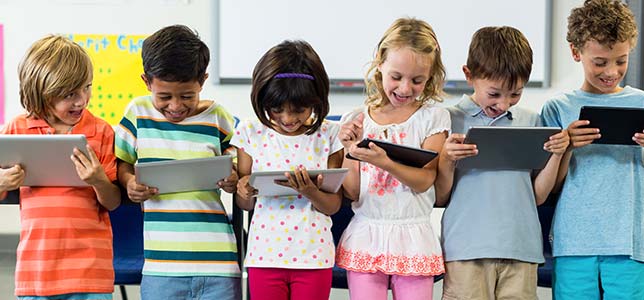
Image Source: https://thejournal.com/articles/2017/06/29/2-in-3-parents-say-classroom-tech-is-key-to-student-futures.aspx

This work is licensed under a Creative Commons Attribution 4.0 International License.

No comments:
Post a Comment